For aging, arthritic & recovering dogs
Help your older dog keep moving — safely, and without the jump.
Practical, measurement-first help for owners of senior dogs: a free dog ramp length & angle calculator, honest buying guides for ramps, lift harnesses and orthopedic beds, and simple home changes that prevent slips and sore joints.
Calculate my ramp length Browse the guides
No sign-up, no pop-ups. The calculator runs instantly on this page.

Start with the right ramp length
Most ramp problems are really angle problems. A ramp that is too short forces a steep climb, which loads the shoulders on the way up and the elbows and wrists on the way down — exactly the joints arthritis affects first. Use the calculator below for a quick answer, or open the full calculator page for the worked examples and measuring guide.
What owners usually need, in order
1 · A gentler way up
Cars, sofas and beds are the three climbs that end first. A correctly sized ramp replaces jumping — the single highest-impact thing a senior dog does.
2 · A hand when legs give out
A lift harness lets you take weight off weak hind legs on stairs, curbs and bathroom trips without lifting the whole dog or hurting your own back.
3 · A home that doesn't fight back
Traction on slippery floors and a supportive, low-entry bed do more for daily comfort than most gadgets. Small changes, big difference.
Popular guides
Ramp vs. stairs for senior dogs
When a ramp is clearly better, when pet stairs are still fine, and the dogs who should use neither without a harness.
Orthopedic beds for senior dogs
Foam types that actually support joints, how thick the foam needs to be for your dog's weight, and entry height mistakes to avoid.
Teach a reluctant dog to use a ramp in 5 days
A flat-on-the-floor training plan that works even for dogs who are already suspicious of new objects.
7 early signs of arthritis owners miss
Slowing down is not always "just getting old." The subtle changes worth raising at your next vet visit.
Why shallower ramps are kinder
On a slope, part of your dog's body weight pulls them down the ramp instead of pressing into the ground. At a 30° incline that backward pull is about half their body weight component along the slope; at 18° it drops to roughly a third. Less pull means less scrambling, less braking with the front legs on the way down, and less force through arthritic hips, elbows and shoulders on every single trip. That is why this site treats 20° as the senior-dog target and 25° as the practical ceiling for most older dogs — and why the calculator asks for your maximum angle before it tells you a length.
This site offers general information, not veterinary advice. If your dog is in pain, newly unable to walk, or suddenly worse, see your veterinarian promptly.
Home › Guides
Best Dog Ramps for Senior Dogs: A Sizing-First Comparison Guide
The “best” ramp is the one that is long enough for your height, wide enough for your dog, and grippy enough that they trust it. Start with our calculator, then match your result to a type below.
Affiliate disclosure: As an Amazon Associate I earn from qualifying purchases. This page contains affiliate links (marked †). We may earn a commission on purchases made through them, at no extra cost to you. Prices checked Oct 2026 — check retailer for current price.
In a hurry? For lower cars and smaller budgets, start with the PetSafe Happy Ride Folding Ramp — $59.99 †, our best budget / car pick. For tall SUVs and trucks, the PetSafe Happy Ride Telescoping XL — $189.99 † is the one long enough to reach a senior-friendly angle. The full comparison is below.
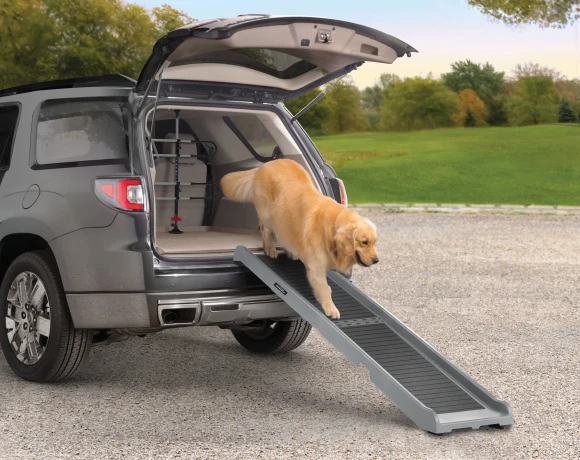
Comparison: real ramps for senior dogs
Prices checked Oct 2026 — check retailer for current price.
| Ramp | Length × width | Capacity | Ramp weight | Price | Best for |
|---|---|---|---|---|---|
| PetSafe Happy Ride Folding | 62″ × 16″, bi-fold | 150 lb | 10 lb | $59.99 | Budget car pick; high-traction treads. Light 150 lb cap — not for giant breeds. |
| PetSafe Happy Ride Telescoping XL | 47–87″ × 20″, telescoping | 300 lb | 18 lb | $189.99 | Tall trucks/SUVs; 87″ at 30″ height ≈ 20°. |
| WeatherTech PetRamp | 67″ × 15″ (folds to 33.5″), bi-fold | 300 lb | 16 lb | $109.95 | Sturdy car ramp; ribbed rubber non-slip surface. |
| Pet Gear Tri-Fold Reflective | 71″ × 19.5″, tri-fold | Not published by retailer | — | $124.84 sale (list $169.99) | Wide, slip-resistant with reflective trim; capacity not published — best for small–medium dogs. |
| DoggoRamps Large Bed Ramp | 70″ walkway, adj. height 12–35″ | 200 lb | 45 lb | $449 | Best indoor/bed pick; solid maple, PAWGRIP anti-slip, folds flat. Premium price. |
What actually matters (and what doesn't)
Length vs. your height — non-negotiable
A 62-inch ramp into a 28-inch-high SUV sits at about 27° — already past the senior ceiling before your dog takes a step. Always divide: angle = arcsin(height ÷ ramp length), or just use the calculator. If a listing doesn't state length, skip it.
Surface grip
Look for high-traction surfaces: ribbed rubber, grit, or carpet with raised rails. Smooth plastic is the #1 reason dogs refuse ramps. Side rails (even 1–2 inches) noticeably increase confidence.
Width and stability
- Small dogs: 14–16 in wide is fine. Medium/large seniors: 18–20 in+. Giant breeds: widest available.
- The ramp should not bounce or shift underfoot — rubber feet and a lip that hooks the car edge help.
- Capacity rating at least 1.5× your dog's weight.
Our shortlist — real ramps, checked Oct 2026
Frequently asked questions
Folding or telescoping — which is better?
Folding ramps are usually lighter and more rigid; telescoping ramps adjust to several heights, handy if one ramp must serve a car and a bed. Either is fine if the deployed length gives you ≤20–22°.
How do I get my dog to actually use it?
Train flat first — see our 5-day ramp training plan. Most refusals are about grip and steepness, not stubbornness.
Can I leave a ramp set up outdoors?
Only models rated for outdoor use. Wood and carpet surfaces degrade in rain; store folding car ramps dry so the grip surface stays effective.
How wide should a ramp be for a large senior dog?
At least 18–20 inches for large breeds, and wider for giants. A ramp that's too narrow makes a big dog hug one edge or step off the side; width is also what makes a ramp feel stable enough to trust. Small dogs manage fine on 15–16 inches.
Telescoping or folding ramp — which is better?
Telescoping ramps adjust their length, so you can hit a gentle angle in different vehicles — the better choice if your dog rides in more than one car or a tall SUV. Folding ramps are simpler and often lighter, but their length is fixed, so check the angle with our ramp calculator before buying. See our dedicated guide to telescoping ramps for large senior dogs.
What weight capacity does my dog's ramp need?
At minimum, your dog's full weight — but choose a rated capacity about 1.5× your dog's weight if you can. Dogs bounce and shift as they climb, and a ramp that flexes underfoot worries them. For dogs over 100 lb, look for 200–300 lb ratings.
Home › Guides
Best Lift Harnesses for Senior Dogs: Front, Rear & Full-Body Support
A lift harness lets you share your dog's weight for a few steps at a time — stairs, curbs, getting up from a nap, steadying a wobbly rear end on a walk. The right style depends on which end needs the help.
Affiliate disclosure: As an Amazon Associate I earn from qualifying purchases. This page contains affiliate links (marked †). We may earn a commission through them at no extra cost to you. Fit and your dog's condition matter more than brand — measure before ordering any harness. Prices checked Oct 2026 — check retailer for current price.
In a hurry? The Help 'Em Up Harness — $80 † is our best overall pick for full front + rear support. The full shortlist and fit guide are below.
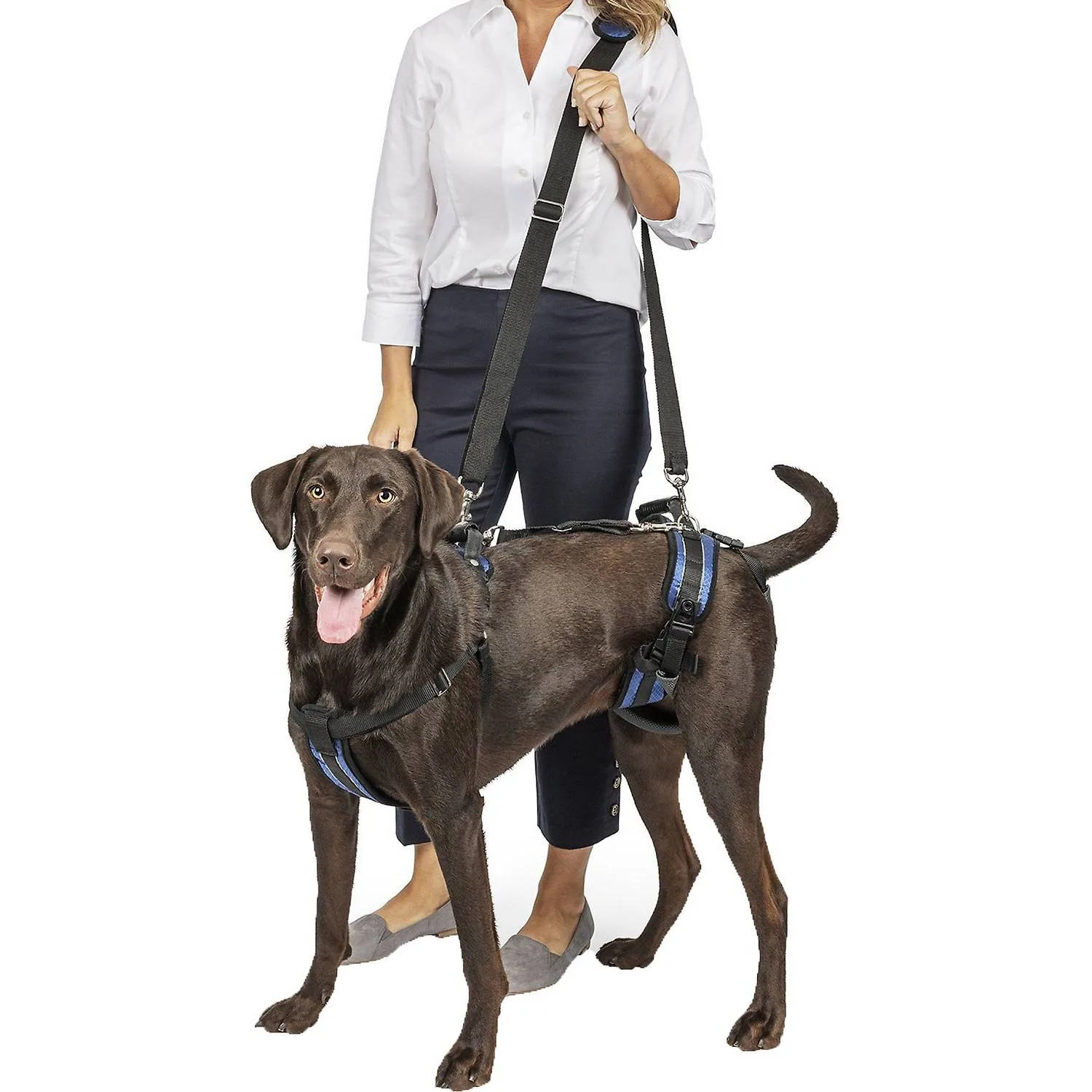
Comparison: real lift harnesses
Prices checked Oct 2026 — check retailer for current price.
| Harness | Type | Sizes / weight range | Price | Best for |
|---|---|---|---|---|
| Help 'Em Up Harness | Full-body front + hip lift | XS 10–25 lb to XL 125–225 lb | $80 | Best overall full support; machine washable. |
| GingerLead Support Sling (M/L Unisex) | Rear-only belly sling | Line spans 10–150+ lb | $69.95 | Best for rear-leg weakness; padded, handle + detachable leash, made in USA, machine washable. |
| PetSafe CareLift Support Harness | Full-body front + rear handles | S 7–35 / M 35–70 / L 70–130 lb | $59.99 | Best value full-body; lifting leash included, machine washable. |
| Ruffwear Flagline Harness with Handle | Full-body walking harness with lift handle | By chest girth, XXS–L/XL | $69.99 | Best for active seniors who still hike/walk; rated 4.8/5 from 905 reviews on ruffwear.com. |
How to fit a lift harness
- Measure girth with a soft tape where the straps will sit — snug, not tight; you should fit two fingers underneath.
- For male dogs, confirm the rear strap/sling design leaves room to urinate, or plan to remove it outdoors.
- Lift only as much as the dog needs — most of the weight should still go through their legs to preserve muscle. You're a spotter, not a crane.
- Check skin after the first few uses; padding matters most at the belly and inside the hind legs.
- Bend your knees and keep the strap close to your body — handler back injuries are the hidden epidemic of senior dog care.
Our shortlist — real harnesses, checked Oct 2026
Prices checked Oct 2026 — check retailer for current price.
Help 'Em Up Harness — $80 †
Best overall / full support. Full-body front + hip lift system, sizes XS (10–25 lb) to XL (125–225 lb), machine washable. The most complete support for stairs, cars, and rising.
GingerLead Support Sling, M/L Unisex — $69.95 †
Best for rear-leg weakness. Padded rear-only belly sling with integrated handle and detachable leash, machine washable, made in USA. The GingerLead line spans dogs 10–150+ lb.
PetSafe CareLift Support Harness — $59.99 †
Best value full-body. Front and rear handles, sizes S 7–35 lb / M 35–70 lb / L 70–130 lb, lifting leash included, machine washable.
Ruffwear Flagline Harness with Handle — $69.99 †
Best for active seniors. Lightweight full-body walking harness with a lift handle, sized by chest girth XXS–L/XL. Rated 4.8/5 from 905 reviews on ruffwear.com — for dogs who still hike and walk daily and need an occasional steadying lift.
Frequently asked questions
Harness or ramp — which do I need?
Often both: the ramp handles planned climbs (car, bed), the harness handles everything else (stairs, curbs, rising). See ramp vs. stairs for help deciding where ramps can't go.
Can a lift harness hurt my dog?
A poorly fitted harness can rub or press on the belly. Fit carefully, pad pressure points, don't suspend the dog fully off the ground unless your vet has shown you how, and stop if your dog shows pain — ask your vet about the right aid for their condition.
How much of their weight should I lift?
Just enough to steady and assist — commonly a small share of body weight. If you are carrying most of the dog, talk to your vet about carts/wheelchairs or a rehab assessment instead.
Should I choose a front, rear, or full-body lift harness?
Match the support to the weakness. Rear support suits hip arthritis and hind-leg weakness (the most common pattern). Front support helps shoulder, elbow, and neck problems. Full-body (front + rear) is the safest choice for IVDD, post-surgery rehab, wobblers, or dogs weak at both ends — and it's the only style that lets two people share the lift.
Can a lift harness replace a ramp?
For two or three steps, often yes — a harness gives you a controlled assist. For daily car loading or a full flight of steps, a ramp is kinder: it removes the lift instead of helping you do it. Many owners end up using both — ramp for the car, harness for the porch steps. Run the numbers on our ramp calculator to see if a ramp fits your space.
How tight should a lift harness fit?
Snug enough that it can't slide or twist under load, loose enough for two flat fingers under every strap. Measure your dog first — chest and hip girth — using our harness measuring guide, then check for rubbing after the first few uses, especially behind the front legs.
Related tools & guides
Home › Guides
Ramp vs. Stairs for Senior Dogs: Which Is Kinder to Old Joints?
Short answer: for most senior and arthritic dogs, a properly sized ramp wins. Pet stairs can still suit some dogs — here's how to tell which one yours is.
The core difference
Stairs concentrate effort into repeated single-leg lifts: each step asks one hip and one knee to raise the whole rear end, then the front legs to brake the landing. A ramp spreads the same climb evenly across all four legs at a steady load — no lifting, no landing impact. The catch is angle: a short, steep ramp recreates the stair problem in a different shape.
| Factor | Ramp (≤20–22°) | Pet stairs |
|---|---|---|
| Joint loading | Even, continuous, lowest impact | Step-by-step peaks; harder on hips/knees |
| Space needed | Long footprint (see calculator) | Compact — fits beside furniture |
| Best for | Arthritis, hip/elbow dysplasia, post-surgery, large seniors | Small, still-agile seniors; low heights (sofa) |
| Learning curve | Needs short training for most dogs | Most dogs take to them quickly |
| Downhill | Controlled walk down | Jumping the last steps is common — and the risky part |
Choose a ramp when…
- Your dog has diagnosed arthritis, dysplasia, or has had joint surgery.
- The climb is a vehicle — jumping down from cars is a top cause of injury flare-ups.
- Your dog hesitates, bunny-hops, or takes stairs one step with both back feet together.
- Your dog is large — stair treads rarely fit a big dog's full stride.
Stairs can still be fine when…
- The height is low (a sofa under ~16 in) and the steps are deep, wide and carpeted.
- Your dog is small, light, and shows no joint diagnosis or hesitation.
- Space truly cannot fit a ramp — then choose the deepest-tread, lowest-rise stairs available and add a harness for assist.
The honest middle ground
Many households end up with both: stairs for the sofa, a ramp for the car, and a harness for the front steps where neither fits. That's not indecision — it's matching the tool to each height. Run each height through the calculator before spending anything.
So which is better for your dog? A verdict by situation
There is no universal winner — there is a right answer for each job in your dog's day. Use this table, then check any ramp with the calculator before you buy.
| Situation | Better choice | Why |
|---|---|---|
| Getting into a car or SUV | Ramp | One smooth climb beats lifting or jumping; stairs tall enough for a cargo floor are steep and tippy. |
| Getting onto a bed or sofa | Ramp (indoor) | Used many times a day; a fixed indoor ramp removes hundreds of joint-loading jumps a month. |
| One or two low porch steps | Either — or a harness | Healthy seniors manage fine; arthritic dogs do better with a short ramp or a lift-harness assist. |
| A full flight of house stairs | Ramp rarely fits — manage access | A kind angle needs enormous length indoors. Most owners gate the stairs and move the dog's life downstairs, using a harness for essential trips. |
| Small dog, low heights, mild stiffness | Stairs can be OK | Wide, deep, carpeted treads at a low total height are a reasonable, cheap option. |
| Post-surgery or IVDD recovery | Ramp + full-body harness | Controlled, supported movement with no jumping — and always follow your vet's restrictions. |
Frequently asked questions
Are stairs bad for all old dogs?
No. Healthy, mobile seniors often manage a few shallow steps fine. The concern grows with diagnosis, size, hesitation, and height. Watch how your dog descends — that's where you learn the truth.
What about the stairs in my house?
Full flights are a different problem: gates to prevent unsupervised use, carpet runners for traction, and a full-body harness for assisted trips. If your dog sleeps upstairs and struggles, moving their bed downstairs is often the kindest fix.
Are pet stairs ever OK for a senior dog?
Yes, in a narrow set of cases: small dogs, mild stiffness only, low total heights, and stairs with wide, deep, carpeted treads. The dog still has to lift each leg and push off arthritic joints — the taller or steeper the steps, the worse it gets.
How many steps before a ramp is the better choice?
As a working rule: three or more steps, or any flight of steps at all, or a dog with diagnosed arthritis at any step count — choose the ramp. One or two low steps with a harness assist is a reasonable middle ground.
My dog refuses the ramp but happily uses stairs. What now?
Don't force it — refusals are usually about confidence or a ramp that's too steep, too narrow, or slippery. Check the angle with our ramp calculator, then rebuild trust with our 5-day ramp training plan. Use a harness assist on the stairs in the meantime.
Which is better after surgery, like TPLO or hip surgery?
Follow your surgeon's instructions first — they override any general guide. In most recoveries, stairs are restricted early on and a ramp plus a full-body harness for support is the standard recommendation, because it avoids both jumping and uncontrolled leg loading.
Home › Guides
Orthopedic Beds for Senior Dogs: Foam, Size & Entry Height That Matter
Senior dogs sleep 12–14+ hours a day, and arthritic joints feel every one of them. A real orthopedic bed distributes weight so hips and elbows don't bottom out on the floor through thin stuffing.
Affiliate disclosure: As an Amazon Associate I earn from qualifying purchases. This page contains affiliate links (marked †). We may earn a commission through them at no extra cost to you. Prices checked Oct 2026 — check retailer for current price.
In a hurry? Start with the Barker Beds Original — $249.95 Large †: 7 inches of foam and a 10-year warranty. The full comparison, including the budget FurHaven option, is below.
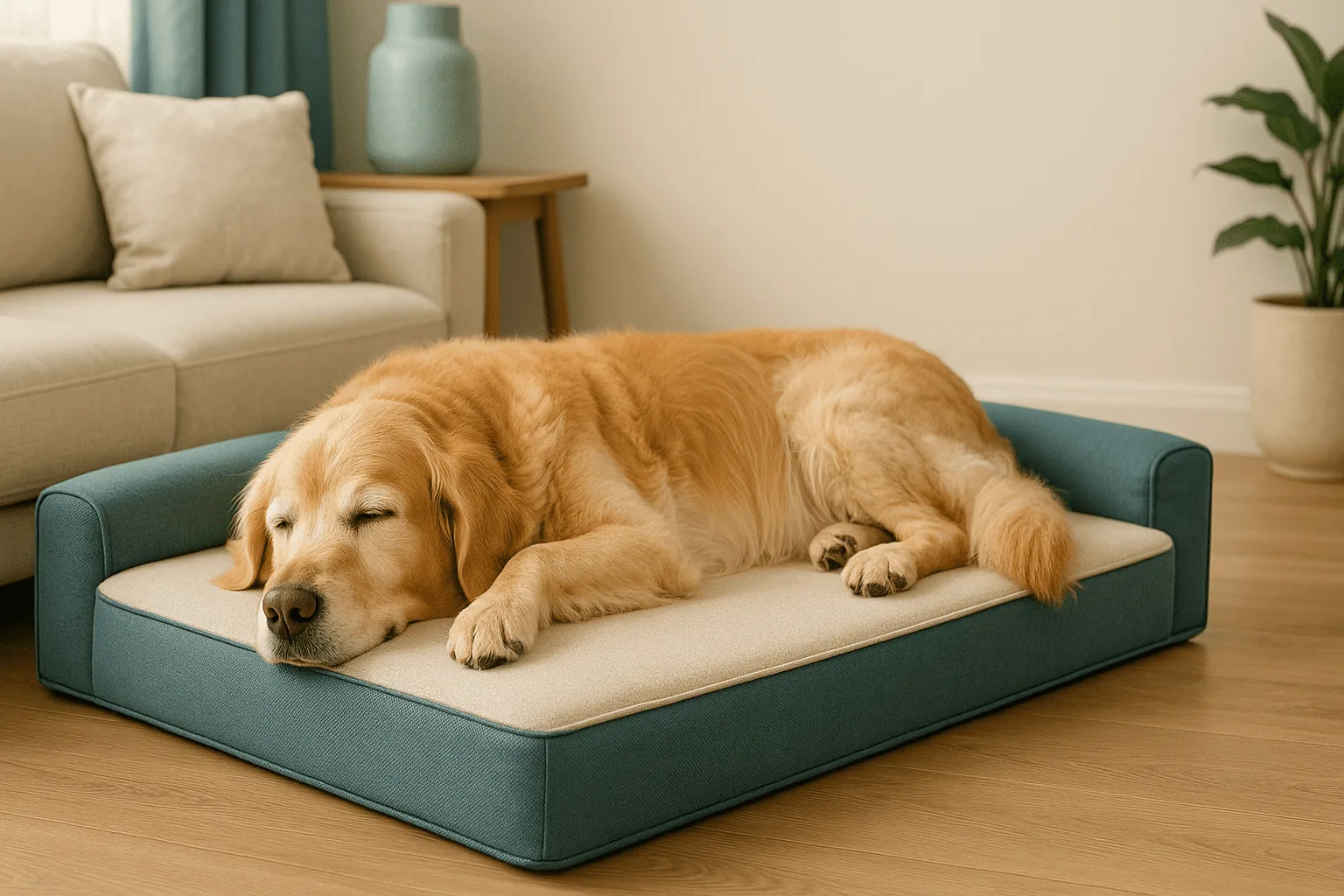
Foam: the only spec that really counts
- Memory foam (4 in+ for large dogs): contours to joints; best pressure relief. Look for a solid slab, not shredded fill.
- High-resilience support foam: firmer, easier for very weak dogs to push up from; often layered under memory foam.
- Egg-crate foam: a budget step up from a standard bed; acceptable for small/medium seniors, often too thin alone for large dogs.
- Avoid: polyester-fill “pillow” beds sold as orthopedic — they flatten in weeks and offer no joint support.
Size and thickness by dog weight
| Dog weight | Minimum foam thickness | Bed length | Notes |
|---|---|---|---|
| Under 25 lb | 3 in | Stretched length + 6 in | Bolsters help small dogs feel secure |
| 25–60 lb | 4 in | Stretched length + 8 in | Measure nose-to-tail-base while sleeping |
| 60–100 lb | 5–6 in | Stretched length + 10 in | Two-layer foam resists bottoming out |
| 100 lb+ | 7 in | Stretched length + 12 in | Check foam density, not just thickness |
Entry height and covers
- Low entry matters: a dog who must climb up into a tall bed loses the benefit. Bolster on 1–3 sides, open on the entry side.
- Removable, washable cover — non-negotiable for seniors prone to accidents. A waterproof liner protects the foam.
- Non-slip base, especially on hard floors (pair with the traction setup).
- Place the bed away from drafts, on the floor your dog actually lives on — not up a flight of stairs.
Our shortlist — real beds, checked Oct 2026
Prices checked Oct 2026 — check retailer for current price.
Barker Beds Original Orthopedic Dog Bed — $249.95 Large †
Best for large/giant seniors. Formerly Big Barker. True 7″ three-layer foam — Large 48″×30″×7″ ($249.95), XL $299.95, Giant $359.95 — with a 10-Year No-Flatten Warranty, CertiPUR-US foam, and a removable washable cover. The thickness that stops big dogs bottoming out.
FurHaven Quilted Sofa Dog Bed — from $32.99 †
Best budget. Convolute orthopedic foam (memory and gel options available), 3″–5″ foam depending on size, with a zippered washable cover. Medium starts at $32.99 — an honest step up from a pillow bed without the premium price.
Orvis Memory Foam Lounger Dog Bed — $209 †
Best premium mid-size. 4″ CertiPUR-US memory foam, sizes M 36″×24″ to XL 48″×32″, machine-washable cover. Listed at $209 (on sale at $156.75 when checked Oct 2026).
Frequently asked questions
How long does an orthopedic bed last?
Quality foam typically supports well for 2–4 years. If you can feel the floor through the foam with your knee and full weight, it's done — replace it.
Heated beds — good idea?
Gentle warmth can comfort stiff joints, but only use pet-specific, low-voltage, chew-resistant models, and always give the dog a non-heated option to move to. Ask your vet first for dogs with reduced sensation.
How thick should an orthopedic dog bed be?
Match foam to weight: roughly 3–4 inches for dogs under 50 lb, 4–5 inches for 50–100 lb, and 5–7 inches for dogs over 100 lb. The test is simple — when your dog lies down, no part of them should press through to the floor. Press the foam with your hand; if you easily feel the floor, it's too thin for your dog.
Memory foam or regular supportive foam — which is better?
A dense, supportive base matters more than the label. Pure soft memory foam can let a heavy dog sink and struggle to rise; a firmer support layer with a thinner comfort top usually works better for seniors who need to push up to standing. Our bed size guide by weight covers foam and sizing together.
How big should my senior dog's bed be?
Measure your dog from nose to tail base while sleeping, then add 6–12 inches in each direction so they can stretch out fully — arthritic dogs change position often and need room to do it. When between sizes, size up.
Do orthopedic beds really help arthritis?
They help with comfort and rest quality: even support takes pressure off hips, elbows, and shoulders, and good sleep is when joints recover. A bed isn't a treatment — weight management, vet care, and daily movement matter more — but a floor or a worn-out bed actively makes stiff mornings worse.
Related tools & guides
Home › Guides
Non-Slip Flooring & Home Setup Guide for Senior Dogs
Hardwood, tile and laminate are ice rinks to an arthritic dog. Slipping doesn't just risk injury — it teaches dogs to fear moving at all, which accelerates muscle loss. Traction is the cheapest mobility aid there is.
Map the routes, then fix them
Walk your dog's actual day: bed → water → door → food → favorite spot. You don't need to cover every floor — you need unbroken traction along those routes, plus at turning points and in front of the bed, bowls and doors, where dogs push off and stop.
Options compared
| Option | Best for | Cost level | Notes |
|---|---|---|---|
| Washable low-pile runners (rubber-backed) | Hallways, routes to the door | Low | The workhorse fix. Rubber backing essential — loose rugs slide. |
| Interlocking foam / rubber mats | Feeding stations, bed areas, play zones | Low–medium | Easy to trim; choose dense mats that nails can't shred. |
| Yoga mats (spare / budget) | Temporary routes, rehab corners | Low | Great grip; not chew-proof — supervise chewers. |
| Toe grips / paw wax / grip socks | Dogs who won't tolerate mats everywhere | Low, ongoing | Mixed results — socks twist on some dogs; grips need correct sizing. |
| Full-room low-pile carpet / large rug | The room the dog lives in | Medium | Anchor edges; low pile so toes and wheels don't catch. |
Room-by-room checklist
- Bed area: non-slip surface at the bed's edge — rising is the hardest move of the day. Raised bowls nearby so the trip is short.
- Feeding: mat under bowls; raised feeder at elbow height for large arthritic dogs (ask your vet — raised bowls aren't right for every breed).
- Stairs: carpet treads or a runner, a gate for unsupervised times, and good lighting — senior eyes adjust slowly.
- Entrances: a mat inside the door for wet paws; keep a towel there in winter.
- Lighting: night-lights along the route to the door. Vision loss + slippery floors + darkness is the classic 2 a.m. fall.
- Nails: keep nails short — long nails change paw angle and reduce grip on any surface.
Frequently asked questions
My dog avoids the runners. Why?
New textures can worry cautious seniors. Lay runners along (not across) their usual path, let them investigate off-duty, and reward crossing them. Most dogs adopt them within days once they feel the grip.
What's the single highest-value change?
A rubber-backed runner from the bed to the water bowl and door. It covers the two hardest moves — rising and setting off — for the price of a pizza.
What's the cheapest non-slip fix that actually works?
Runners along your dog's actual routes — bed to door, door to bowl — laid on washable rug pads or non-slip underlay. Cover the paths, not the whole room; it's cheaper and it's where slips happen. See the full comparison in our guide to the best non-slip flooring for senior dogs.
Do toe grips, socks, or paw wax work?
They're a second layer, not a fix. Some dogs tolerate toe grips well; many kick socks off or walk worse in them, and wax wears off quickly. Start with floor coverage and trimmed nails (long nails push toes apart and reduce pad contact), then add grip aids if your dog accepts them.
Is carpet or hardwood better for an arthritic dog?
Carpet gives far better traction and softer falls — if you're choosing flooring, carpet or carpet tiles win for a senior dog. With hardwood you already have, the goal is to carpet the routes: runners, mats at beds and bowls, and a ramp instead of any jumping.
How do I stop slips at the door and water bowl?
A mat with a rubber backing under and around the water bowl (drips make tile treacherous), a runner inside every exterior door, and decent lighting on the route — senior eyes adjust slowly, and a dog that can't see the edge of a mat may step around it. Our home setup checklist walks the whole house zone by zone.
Related tools & guides
Home › Resources
Guides & Resources for Senior Dog Owners
Substantial, practical articles — no thin listicles. Plus our product guides: ramps, lift harnesses, orthopedic beds, ramp vs. stairs, and non-slip home setup.
Mobility basics
7 early signs of arthritis owners miss
The subtle changes — lagging, licking joints, bunny-hopping — that often appear a year before obvious limping.
8-minute read
Car & Travel
How to help a senior dog get into the car
Ramp, harness assist, steps, or a careful lift — the four options compared, with the ramp-length math for your vehicle's load height.
7-minute read
Training
Teach a reluctant dog to use a ramp in 5 days
Flat-first, treats-on-the-board ramp training that builds trust before height, for dogs of any age.
7-minute read
Health
Weight: the kindest joint medicine you control
Why a few pounds matter so much to arthritic joints, how to check body condition at home, and safe ways to help a senior lose weight.
8-minute read
Daily care
A gentle daily routine for a stiff, sore dog
Short frequent walks, warm-up thinking, rest balance, and the small rituals that keep senior muscles from fading.
7-minute read
Sizing, angles & home setup
Specific answers to the questions owners ask right after the calculator:
- How Long Should a Dog Ramp Be for a 30-Inch SUV?
- Best Ramp Angle for Arthritic or Senior Dogs
- Best Telescoping Dog Ramps for Large Senior Dogs
- How to Measure for a Dog Lift Harness
- Orthopedic Dog Bed Size Guide by Weight
- Best Non-Slip Flooring for Senior Dogs
- Home Setup Checklist for Senior Dogs with Mobility Issues
7 Early Signs of Arthritis in Dogs That Owners Miss
Dogs rarely cry out about joint pain. They quietly do less. Catching arthritis early — before muscle wastes and pain becomes constant — gives your vet far more to work with.
1. Lagging behind on walks
The dog who used to pull ahead now trails, sniffs more (a polite way to stop), or wants to turn for home early. It's often filed under “slowing down,” but a change in walk enthusiasm is one of the earliest measurable signs of joint pain.
2. Hesitation before jumping, stairs, or the car
Pausing, circling, false starts, or waiting to be lifted. Dogs calculate: if the last jump hurt, they think first. This is exactly when a ramp prevents the problem from becoming a refusal — or an injury.
3. Stiffness after rest that “warms out”
Slow, stiff first steps after a nap that loosen after a few minutes of moving is a textbook arthritis pattern — different from constant weakness, which needs prompt veterinary attention.
4. Bunny-hopping and gait changes
Moving both hind legs together on stairs or at a run, swaying hips, scuffed rear nails, or a shortened stride. Film a 20-second video on a flat surface — it's genuinely useful at the vet visit.
5. Licking or chewing at a joint
Dogs lick where it aches: wrists, elbows, hips. Lick stains or hair loss over a joint, with no skin problem found, point underneath — to the joint itself.
6. Less interest in play, and grumpiness about touch
Snapping when a hip is touched, moving away from the grandkids, sleeping in new, quieter places. Pain shortens patience in dogs just as it does in people.
7. Muscle loss over the hips and thighs
Run your hands over both sides: arthritic legs get used less and waste, which makes the joint less supported — a vicious circle that early exercise and pain control can slow.
What to do with this list
- Book a vet visit and bring notes: when it started, what's changed, a gait video.
- Don't start human painkillers — several are toxic to dogs. Vet-prescribed options exist.
- Start the home side now: traction, weight check, a ramp for the car, shorter more frequent walks.
General information only — not a diagnosis. Sudden inability to stand or walk, crying out, or dragging limbs needs same-day veterinary care.
Teach a Reluctant Dog to Use a Ramp in 5 Days
Most ramp refusals aren't stubbornness — the ramp is new, it moves, it smells odd, and it's steep. Train it flat on the floor first, and height becomes a non-event.
Before day 1: set yourself up to succeed
- Confirm the ramp is long enough (run your numbers in the calculator). Training can't fix a 30° slope — if yours is steeper than about 20°, fix the setup first with our guide to the best ramp angle for arthritic dogs.
- Check the surface: add grip tape or a carpet strip if paws slip at all.
- Use high-value treats your dog only gets for ramp work, and keep sessions to 3–5 minutes.
Day 1 — The ramp is furniture
Lay the ramp flat on the floor in a room your dog likes. Treats for looking at it, sniffing it, touching it with a paw. Scatter a few treats on it and let the dog “find” them. Done.
Day 2 — Walk the plank
Still flat. Lure your dog to walk its length, treating every few steps. If they hop off the side, that's information, not failure — narrow the “runway” with a sofa on one side and your legs on the other so the ramp is the obvious path.
Day 3 — A tiny hill
Raise one end 2–4 inches (on a book stack or low step). Walk up and down. Dogs learn descent confidence separately — practice both directions every session from here on.
Day 4 — Half height, real location
Move the ramp to the car/sofa with the far end on a halfway support if possible, or simply do short sessions at full height with you spotting beside them, harness on. Jackpot treats at the top.
Still deciding between a ramp, a harness boost, and steps for the car? See how to help a senior dog get into the car for the full comparison.
Day 5 — The real thing, unhurried
Full setup, real trip. Walk beside the ramp (never drag by the leash), treat at the top, and celebrate like they invented it. Most dogs need a week or two of supervised use before it's automatic — that's normal.
Troubleshooting
- Jumps off the side: too steep, too slippery, or training moved too fast. Drop a step back and add side rails.
- Freezes midway: don't coax from the top with the leash tight. Walk back down with them, reward, end on that win.
- Fine up, scared down: descent loads the front legs and feels riskier. Lower the angle and practice extra descents.
Weight: The Kindest Joint Medicine You Control
Extra pounds multiply force through every arthritic joint on every step. The good news: weight is the one arthritis factor entirely in the owner's hands — and modest losses bring visible changes in mobility.
Why a “few pounds” isn't a few
A dog 10% over ideal weight carries that surplus through thousands of steps a day, and the load through a joint during movement is a multiple of body weight, not equal to it. Vets routinely see dogs move noticeably better after losing just 5–10% of body weight — often the cheapest “treatment response” in arthritis care.
Check body condition at home
- Ribs: you should feel them easily under a thin fat cover, like the back of your hand — not see them, and not hunt for them.
- From above: a visible waist behind the ribs.
- From the side: the belly tucks up rather than hanging level with the chest.
- Weigh monthly on the same scale (vet offices will usually weigh free) and write it down.
Safe senior weight loss
- Ask your vet for a target weight and daily calorie goal — seniors need protein protected even in a calorie deficit to keep muscle.
- Measure food with a scale or cup, every meal. “Eyeballing” is how diets fail.
- Budget treats at ~10% of calories: swap in green beans, carrot coins, or a portion of their kibble.
- Feed the dog you want: rations are based on ideal weight, not current weight.
- Keep activity gentle but daily — short frequent walks burn calories without battering joints.
- Expect ~1–2% of body weight per month. Slow is safe and sustainable.
Frequently asked questions
My senior is losing weight without trying — good?
No — unexplained weight loss in an older dog is a vet-visit item, not a win. It can signal disease or muscle loss that needs attention.
Are “senior” foods automatically better?
Not automatically. Compare calories per cup and protein on the label, and choose based on your vet's target for your dog — the word “senior” on the bag is marketing, not a standard.
Related tools & guides
A Gentle Daily Routine for a Stiff, Sore Dog
Arthritic dogs do best on boring consistency: the same gentle movement, at the same times, every day — including weekends. Here's a template to adapt with your vet's input.
The shape of the day
Morning: wake the joints up slowly
Expect the worst stiffness after the longest rest. Let the dog rise in their own time on a non-slip surface, take a short toilet walk (5–10 minutes, flat), and save longer walks for later when they've loosened up. If your vet has prescribed morning pain relief, timing it before this first walk is a common pattern — follow their instructions.
Midday & afternoon: little and often
- Three to five walks of 10–20 minutes beat one 60-minute march for arthritic joints.
- Flat, even surfaces; grass is friendlier than pavement if footing is secure.
- Let sniffing set the pace — mental exercise tires seniors kindly.
- Skip the ball-thrower: sprint-stop-twist is the worst load pattern for bad hips and elbows.
Evening: wind down, warm up
A final short walk, then settle on their orthopedic bed away from drafts. Some dogs visibly relax with a warm (not hot) compress over stiff hips for a few minutes — if they lean into it, it's helping; if they move away, stop.
The weekend-warrior trap
The most common owner mistake: couch-level weekdays, then a huge Saturday hike “because she seemed fine.” Sore Sunday-through-Tuesday is the receipt. Keep weekend activity within ~20% of weekday totals and build up over weeks if you want more.
Track it simply
A one-line daily note — walk lengths, stairs managed, stiffness score 1–5 — turns “I think he's worse” into data your vet can act on, and shows you what's working. Bring it to every recheck.
Frequently asked questions
How much exercise is too much?
If stiffness or limping is clearly worse for more than a few hours after a walk, that walk was too long. Cut 25% and rebuild slowly. Resting entirely is rarely the answer — muscle is joint protection.
Should I stop walks on bad days?
Shorten, don't skip, unless your vet says otherwise: a 5-minute flat toilet walk keeps joints moving and muscles engaged. A dog who refuses to walk at all needs a vet call.
Related tools & guides
Home › About
About Senior Dog Mobility
Senior Dog Mobility exists for one reader: the owner of an older dog who has started to hesitate at the car, the stairs, or their own bed — and who wants clear, practical answers instead of sales pressure.
Who this site is for
- Owners of aging dogs (typically 7+ years, earlier for giant breeds).
- Owners of dogs with arthritis, hip or elbow dysplasia, or recovering from orthopedic surgery.
- Anyone measuring a car, sofa, or staircase and wondering “how long should this ramp actually be?”
How we make recommendations
- Measurements first. Our guides lead with the numbers — ramp geometry, foam thickness by weight, girth measurements — because fit decides whether a product works, not branding.
- Real products, real specs. We name specific products only with specifications and prices verified on the manufacturer or a major retailer page (checked Oct 2026), and we say so plainly when a maker doesn't publish a spec — like a missing weight capacity — instead of inventing one.
- Conservative health framing. We describe general information and common veterinary practice patterns. We don't diagnose, and we tell you plainly when something needs your vet.
- Conflicts disclosed. Some links are affiliate links (always marked † with a disclosure on the page). Commissions never change the sizing math or which type we rank first for a given situation.
What we are not
We are not a veterinary practice, and nothing here replaces one. Product prices and specifications were checked in Oct 2026 — verify current specifications, sizing, and prices with the seller before buying, as they change.
Questions or corrections? We genuinely want them — contact us.
Home › Contact
Contact Us
Questions about a guide, a correction, or a ramp measurement that doesn't seem right? Send us a message — sizing questions are our favorite kind.
Response times
We read everything and reply to most messages within 2–3 business days. Please don't send urgent veterinary questions — a dog in pain or unable to walk needs a veterinarian today, not an inbox.
Home › Legal
Privacy Policy
Last updated: October 15, 2026
This Privacy Policy explains what information Senior Dog Mobility (“we”, “the site”) collects, why, and the choices you have. By using the site you agree to this policy.
Information we collect
- Information you send us: if you email or use the contact form, we receive your name, email address, and message so we can reply.
- Calculator inputs: the ramp calculator runs entirely in your browser. Heights and angles you enter are not transmitted to or stored by us.
- Basic technical data: like most websites, hosting and analytics may log IP address, browser type, and pages visited to keep the site secure and understand which guides are useful.
Cookies and advertising
We may display advertising, including through Google AdSense. Third-party vendors, including Google, use cookies to serve ads based on a user's prior visits to this and other websites. Google's use of advertising cookies enables it and its partners to serve ads based on visits to this site and/or other sites on the Internet. You may opt out of personalized advertising by visiting Google Ads Settings, and learn more at Google's advertising policies. We also use affiliate links; affiliate partners may use cookies to attribute purchases, as described in their own privacy policies.
How we use information
- To operate, secure, and improve the site and its guides.
- To respond to messages you send us.
- To comply with legal obligations.
Sharing
We do not sell personal information. We share data only with service providers needed to run the site (hosting, analytics, advertising) under their terms, or when required by law.
Your choices
- Block or delete cookies in your browser settings (the site and calculator will still work).
- Opt out of personalized ads via the Google Ads Settings link above.
- Email hello@seniordogmobility.example to ask what personal information we hold about you or to request its deletion.
Children
The site is written for adult pet owners and is not directed at children under 13; we do not knowingly collect their information.
Changes
We will post updates to this policy on this page with a new “last updated” date.
Home › Legal
Terms of Service & Disclaimer
Last updated: October 15, 2026
Using this site
By using Senior Dog Mobility you agree to these terms. Content is provided for general information and education. We work to keep measurements and guidance accurate but make no warranty that content is complete, current, or right for your dog's situation.
Not veterinary advice
Nothing on this site is veterinary or medical advice. We do not diagnose conditions or prescribe treatment. Always consult a qualified veterinarian about your dog's health, pain, mobility changes, or before starting exercise, weight-loss, or rehabilitation programs. If your dog cannot stand or walk, is crying out, or has suddenly worsened, seek veterinary care immediately.
Calculator results
The ramp calculator computes standard right-triangle geometry (ramp length = height ÷ sin(angle); run = height ÷ tan(angle)). Results are planning estimates: measure your actual setup, account for ramp lips, hooks and surface compression, and supervise your dog's first uses of any mobility aid.
Affiliate disclosure
Some links on this site are affiliate links, marked with † and a disclosure on the page. If you buy through them we may earn a commission from the seller at no additional cost to you. Product specifications and prices were checked in Oct 2026 and change — verify details with the seller before purchase. Mention of a product is not a guarantee of suitability for your dog.
External links
We are not responsible for the content, policies, or practices of third-party websites linked from this site.
Liability
To the extent permitted by law, we are not liable for losses arising from reliance on site content or from the use of products discussed here. You are responsible for your dog's safety: introduce mobility aids gradually, supervise use, and stop if your dog shows pain or distress.
Intellectual property
Site text and design are © Senior Dog Mobility unless otherwise noted. You may link to and quote brief excerpts with attribution; please don't republish full guides without permission.
Changes
We may update these terms; continued use after changes are posted constitutes acceptance.
Home › Guides
How to Measure for a Dog Lift Harness
Five minutes and a soft tape measure are the difference between a harness that lifts safely and one that twists, rubs, or slips. You need three measurements — chest girth, hip girth, and (for full-body harnesses) torso length — plus an honest weight.
What you need
- A soft tailor's tape — or a length of string plus a ruler or metal tape.
- Your dog standing on a non-slip surface (a mat helps arthritic dogs stand still).
- Treats. Measuring goes better with bribery.
The measurements, step by step
- Chest girth: wrap the tape around the widest part of the ribcage, just behind the front legs. Snug, not tight — you should slide two fingers under it. Note the number in inches.
- Hip girth: wrap around the hips at their widest point, just in front of the rear legs. This is the number rear slings and full-body harnesses are sized by.
- Torso length (full-body harnesses only): measure along the side from the chest measurement point to the hip measurement point. Full-body harnesses bridge the two, and a bridge that's too short pulls at both ends.
- Weight: use a recent vet weight if you have one. Harnesses have weight ratings too — a harness near its limit stretches and twists under load.
Which measurement sizes which harness
| Harness style | Sized mainly by | Also check |
|---|---|---|
| Front support | Chest girth | Neck opening; no pressure on the throat |
| Rear sling / rear lift | Hip girth | Routing for male dogs; padding width |
| Full-body (front + rear) | Chest girth, hip girth, torso length | Handle position over the dog's center of mass |
Compare your numbers against the verified picks and their size ranges on our Best Lift Harnesses for Senior Dogs page.
The fit check (do this indoors first)
- Two flat fingers fit under every strap.
- Lift gently: the harness should support without the dog swinging, twisting, or the straps migrating toward the neck or tail.
- Walk a few assisted steps and check rub points — behind the front legs and inside the thighs are the usual spots.
- For rear support, confirm the dog can still toilet with the harness on, or that it's quick to slip off.
Still deciding between a harness and a ramp? Our ramp vs stairs verdict covers when lifting help is the right tool — and the ramp calculator shows whether a ramp would fit your space at all.
Frequently asked questions
My dog is between sizes. Which do I pick?
Follow the maker's chart, but as a rule: for chest-strap and full-body harnesses, size up so straps don't dig in under load; for rear slings, the maker's guidance matters most because a sling that's too wide chafes. If the brand offers exchanges, order with the measurements in hand and test the fit indoors first.
Can I measure my dog lying down?
You can, but add a little: muscles relax and girth reads smaller than standing. Standing measurements match how the harness actually works. If your dog can't stand for long, measure lying and add about an inch to girth, then do the two-finger check carefully at first use.
How often should I re-measure?
Whenever your dog's weight changes noticeably, and at least every six months for a senior. Weight loss is common (and often desirable) in arthritic dogs, and a harness fitted to a heavier dog can slide at exactly the wrong moment. See our guide on weight and arthritis for the joint side of that story.
Do male dogs need a different fit?
Yes — check rear sling and full-body harness designs for how they route around a male dog's anatomy. Many makers note this in their sizing guidance. After fitting, take a short assisted walk and confirm nothing is being compressed or rubbed before you rely on it on steps.
Home › Guides
Best Telescoping Dog Ramps for Large Senior Dogs
For a large senior dog and a tall vehicle, telescoping ramps solve the one problem folding ramps can't: length you can adjust to hold a kind angle. But "telescoping" on the box guarantees nothing — width, capacity, surface, and flex decide whether a big dog will actually trust it.
Why length adjustability matters for big dogs
Large dogs ride in tall vehicles, and tall vehicles demand long ramps. At the senior target of 20°:
| Vehicle height | Length at 20° | Length at 18° |
|---|---|---|
| 26 in | 76.0 in | 84.1 in |
| 30 in | 87.7 in | 97.1 in |
| 34 in | 99.4 in | 110.0 in |
The longest common telescoping ramps extend to about 87 inches — enough for 20° at a 30-inch height, but only about 23° at 34 inches. If your vehicle is that tall, pair the ramp with a curb or sloped parking spot to cut the effective height (worked example on our 30-inch SUV ramp page), and always confirm your numbers in the calculator.
The checks that actually matter
- Extended length — shop by the extended number, never the collapsed one.
- Width 20 inches — large dogs step off narrow ramps; width is confidence.
- Capacity 250–300 lb — and at least 1.5× your dog's weight, so the surface stays steady under a shifting, bouncing climb.
- Surface — high-traction rubber or grit tread that grips when wet; smooth carpet-style surfaces get slick.
- Ramp weight — typically 15–20 lb for this class. If you'll deploy it several times a day, every pound matters to your back.
- Locking and rails — sections should lock positively at length, and low side rails help a dog track straight.
How the types compare
| Type | Typical length | Best for | Watch out |
|---|---|---|---|
| Telescoping (2-section aluminum) | 47–87 in, adjustable | Tall SUVs/trucks, multiple vehicles, large dogs | Heavier; flex at full extension on cheap models |
| Tri-fold | ~71 in, fixed | Moderate heights, simple setup | Fixed length = fixed angle; check it before buying |
| Bi-fold | ~62 in, fixed | Low cars, small–medium dogs | Too short (too steep) for tall vehicles and big seniors |
Our verified telescoping pick — with current pricing and full specs — is on the Best Dog Ramps for Senior Dogs page. And if your dog is new to ramps, budget a few days for the 5-day training plan; a ramp a big dog refuses is just luggage.
Frequently asked questions
How long a telescoping ramp does a large dog need?
Work from your vehicle height, not the dog's size: at 20°, a 30-inch cargo floor needs about 88 inches — near the maximum extension of the longest common telescoping ramps (about 87 inches). Large dogs add two requirements on top: width of 20 inches and a 250–300 lb capacity rating.
Are telescoping ramps sturdy enough for a 100+ lb dog?
The good ones are — aluminum telescoping ramps are commonly rated to 300 lb. What matters is flex at full extension: a ramp that bows makes dogs cautious. Choose a model rated at least 1.5× your dog's weight and test it at full extension on day one, while returns are easy.
Telescoping or tri-fold for a big dog?
Telescoping wins on angle control — you can match length to the vehicle and the parking spot. Tri-folds (commonly about 71 inches) are simpler and stable but fixed-length: at 30 inches of height that's a 25° climb, the senior ceiling. For tall vehicles and arthritic dogs, adjustability usually wins.
Can I use a telescoping ramp indoors, for a bed?
You can, but it's rarely the best tool: car ramps are long, hard-edged, and built to fold away, not to live beside a bed. A fixed indoor bed ramp with a grippy surface is kinder for many-times-a-day use. See the indoor pick on our ramps page.
Home › Guides
Orthopedic Dog Bed Size Guide by Weight
The right orthopedic bed size comes from two numbers: your dog's sleeping length and their weight (which sets the foam thickness). This guide gives you both — a size chart to start from, and a two-minute measurement that overrules it.
Bed sizes by weight
| Dog weight | Bed size | Typical bed dimensions | Foam thickness |
|---|---|---|---|
| Under 25 lb | Small | ~24 × 18 in | 3 in |
| 25–45 lb | Medium | ~30 × 21 in | 3–4 in |
| 45–75 lb | Large | ~36–42 × 27–28 in | 4–5 in |
| 75–110 lb | XL | ~48 × 30 in | 5–7 in |
| 110 lb and over | Giant | ~54–60 × 36 in | 7 in |
Dimensions vary by brand; treat these as the floor, not the ceiling. Foam thickness is the support minimum for that weight — the hand test below is the real check.
Measure your dog (the number that matters most)
- Wait until your dog is asleep in their usual position.
- Measure from nose to the base of the tail — not the tail tip.
- Add 8–12 inches. That's your minimum bed length. For width, a stretched-out sleeper needs roughly their length × 0.7.
- Between sizes? Size up. Arthritic dogs reposition often and need room to do it without stepping off the bed.
Foam: thickness is only half the story
Density keeps a heavy dog from bottoming out; thickness alone doesn't. Press any bed hard with your hand where your dog's hips will rest: if you feel the floor, it will not support a dog of that weight, whatever the label says. A firmer support base with a thinner comfort layer usually beats deep, soft foam for seniors who must push themselves up to standing. Our Orthopedic Beds for Senior Dogs page applies these rules to verified beds with real dimensions.
Don't forget the step up
A bed that's perfect lying down can still fail at getting in and out. Keep the total height (frame + foam, compressed) low enough for a step, not a hop — and if your dog also gets on your bed or the sofa, that's a ramp question: size it with the ramp calculator and cover the surrounding floor using our home setup checklist.
Frequently asked questions
Should I size by weight or by length?
Length first, weight second. Weight charts get you to the right neighborhood, but a long, lean dog needs more bed than a compact dog of the same weight. Measure your dog sleeping nose-to-tail-base and add 8–12 inches — that number outranks any chart, including ours.
Is a bolster bed or a flat bed better for arthritis?
Flat (or low-bolster) beds are easier to get on and off and let a dog stretch fully — important for stiff joints. Bolsters suit dogs who like to rest their head up or lean. If your dog struggles to step over a bolster to get in, choose flat with a separate pillow.
How low should the entry be?
The dog should step onto the bed, not climb or hop. For most seniors that means a sleeping surface around 4–7 inches high including foam compression — thick foam in a raised frame can quietly become a climbing problem. Floor-level beds are the safest default.
When is it time to replace an orthopedic bed?
Do the hand test: press the foam where your dog's hips rest. If you can feel the floor through it, or the foam stays dented after your dog gets up, the support is gone — for a foam bed that's usually years, not months, if you bought dense foam to begin with.
Home › Guides
Best Non-Slip Flooring for Senior Dogs
Senior dogs slip because hard floors give their pads nothing to hold. You don't need to refloor the house — you need traction on the routes your dog actually walks. This page compares every realistic option by grip, cost, cleaning, and where it works best.
The options, compared
| Option | Traction | Cost | Cleaning | Best for |
|---|---|---|---|---|
| Washable runners + non-slip pads | Excellent | $ | Machine wash | Routes and hallways; renters; first fix for almost everyone |
| Low-pile area rugs + underlay | Very good | $$ | Vacuum; spot clean | Living areas and bed surrounds |
| Carpet tiles | Excellent | $$ | Swap single tiles | Whole rooms; accidents (replace one tile, not a rug) |
| Interlocking foam tiles | Very good | $ | Wipe; lift to deep-clean | Play/rest zones; cushioning for dogs who fall |
| Textured vinyl plank (LVP) | Good | $$$ | Mop | Remodels; waterproof hard-floor compromise |
| Toe grips / paw grips | Fair (adjunct) | $ | n/a | Extra help on top of floor coverage — not a substitute |
Where to put traction first
- The route from bed to door — the morning trip, when joints are stiffest.
- Around the bed itself — most falls happen getting up, when a hind foot slides out during the push to standing.
- Water and food bowls — drips turn tile into ice.
- Entry doors and any step-downs — momentum plus a threshold is a classic slip.
Our room-by-room Non-Slip Home Setup Guide turns this into a full walkthrough, and the Home Setup Checklist puts it in priority order with everything else (lighting, feeding, sleeping).
Renters vs owners
Renters: runners, rugs, carpet tiles with releasable tabs, and foam tiles all leave without a trace — you can solve the whole problem for the cost of a few runners. Owners remodeling anyway: textured LVP or carpet in the dog's main rooms removes the problem permanently, but still keep the bed surround soft — falls happen even on grippy floors, and an arthritic hip prefers a padded landing.
Keep nails short, whatever you choose
Long nails push a dog's toes up and apart, shrinking pad contact with the floor — the equivalent of walking in high heels. Regular trims (or a grinder for dogs who hate clippers) make every surface on this page work better. And for getting up from the floor itself, a lift harness gives you a handle to steady the first, slip-prone steps.
Frequently asked questions
What is the single best non-slip option for a senior dog?
For most homes: washable runners with non-slip pads along your dog's real routes. They give carpet-level traction exactly where slips happen, they're cheap per foot, they wash, and they work for renters. Everything else on this page solves a problem runners don't — whole rooms, chewers, incontinence, or a remodel.
Are interlocking foam tiles safe for dogs?
Mostly yes, with two cautions: some dogs chew exposed foam edges (supervise, or run tiles wall-to-wall under furniture edges), and urine works into the seams, so they're a poor choice where accidents are frequent unless you seal or lift and wash them regularly.
Does luxury vinyl plank really grip?
Textured LVP grips far better than polished hardwood or tile, and it's waterproof and scratch-tolerant — the best hard-floor compromise if you're remodeling anyway. It's still not carpet: keep a runner on the bed-to-door route.
How much flooring do I actually need to cover?
Less than you think. Map the routes: bed → water → door → favorite spot. Cover those paths plus a landing zone around the bed and bowls first — for most homes that's 15–25 feet of runners and two mats — then add rooms only if you see slips there.
Home › Guides
Home Setup Checklist for Senior Dogs with Mobility Issues
Work through this list zone by zone, in the order given — the first zones prevent the most falls. Most of it is a weekend of small jobs, and almost none of it needs a contractor.
1 · Floors & routes (do these first)
- ☐ Runner with a non-slip pad on the bed-to-door route
- ☐ Mat or rug surrounding the bed — falls cluster around getting up
- ☐ Runner inside every exterior door your dog uses
- ☐ Nails trimmed — long nails shrink pad grip on every surface
- ☐ Routes cleared of clutter, cords, and single shoes (trip hazards at dog height)
Option details and comparisons: Best Non-Slip Flooring for Senior Dogs.
2 · Getting up, down & around
- ☐ Ramp fitted for the car, sized with the ramp calculator (angle 20° or gentler)
- ☐ Ramp or steps decision made for bed/sofa — see the verdict table
- ☐ Full flights of stairs gated, or a harness plan for essential trips
- ☐ Lift harness fitted and kept where you actually need it — by the door, not in a closet (measuring guide)
- ☐ Furniture the dog uses is stable — no rocking chairs or sliding ottomans as launch pads
3 · Eating & drinking
- ☐ Waterproof mat under bowls — drips make floors treacherous exactly where the dog stands longest
- ☐ Bowls stable and non-tipping; raised feeder only if your vet agrees (it suits some neck/shoulder cases, not all)
- ☐ Water available on every floor the dog uses, so stairs aren't a prerequisite for a drink
4 · Sleeping
- ☐ Orthopedic bed sized by the size guide — hips don't bottom out
- ☐ Bed on the ground floor, away from drafts, in a quiet but not isolated spot
- ☐ Bed away from slippery flooring edges — the push to standing starts on the bed surround mat
5 · Night & lighting
- ☐ Low night-lights along the bed-to-door route — senior eyes adapt slowly
- ☐ Outdoor potty spot lit and cleared; a short, grippy path in winter
- ☐ Flashlight by the door for nighttime yard checks
6 · Outside
- ☐ Porch and deck steps checked: a short ramp or harness assist for 3+ steps
- ☐ Yard route free of holes, hoses, and slick decking boards
- ☐ Car loading spot chosen: flat, with room for the ramp's full run
Room-by-room detail lives in the Non-Slip Home Setup Guide; the early-warning signs that it's time to start this list are in 7 Early Signs of Arthritis in Dogs.
Frequently asked questions
What's the single highest-impact change on this list?
Traction on the bed-to-door route. Most senior-dog falls happen on that trip — stiff joints, urgent bladder, hard floor. It's also the cheapest fix on the page: one runner and a non-slip pad.
How long does the full setup take?
A focused weekend for the priority tier (traction, night lighting, bowl mats, one ramp fitted and trained). The rest is one small job at a time. Don't wait for perfect: the top five items prevent the majority of falls and struggles.
My dog shares the home with younger dogs. Any conflicts?
Mostly benefits: runners and ramps get used by everyone. Watch two things — younger dogs treating the ramp as a racetrack (train them separately), and food-station changes: raised feeders and mats should give the senior a calm spot away from competition.
Should my senior dog still use stairs at home?
For a full flight, most owners eventually gate them and move the dog's world downstairs, with a harness-assisted trip only when needed. Our ramp vs stairs verdict walks through the reasoning by situation.
How to Help a Senior Dog Get Into the Car — Without Lifting
When a senior dog can't jump anymore, every vet trip and park visit becomes a lifting problem — for their joints and your back. There are four good ways to solve it, and the right one depends on how much your dog can still do. Here's how to choose, with the numbers that matter.
Start with one measurement: your car's load height
Park on flat ground and measure from the ground to the surface your dog actually steps onto — the cargo floor for a hatch or SUV, or the seat edge for a sedan. Many SUV cargo floors land around 28–32 inches; wagons and sedans are lower. This single number decides everything below: it sets the ramp length, whether steps are realistic, and how much of your dog's weight a harness assist has to carry. If you drive an SUV, our worked example for a 30-inch SUV load height shows the full math.
Option 1 — A ramp (the best default for most senior dogs)
A ramp replaces the jump with a walk, and it's the only option that asks almost nothing of sore hips and shoulders. The catch is angle: a ramp that's too short is just a steep plank. For arthritic dogs, aim for an 18–20° incline — the reasoning is in our guide to the best ramp angle for arthritic dogs. In plain numbers:
- 24-inch load height: about 70 inches of ramp at 20°, 78 inches at 18°.
- 28-inch load height: about 82 inches at 20°, 91 inches at 18°.
- 30-inch load height: about 88 inches at 20° — which is why the longest telescoping ramps (around 87 inches extended) exist: they're sized by this math.
Run your own height through the ramp calculator for exact figures, including the floor space the ramp will occupy. If a full-length ramp won't fit your parking spot, park with the rear wheels at a curb or on a gentle slope — dropping the effective height by even 3–4 inches noticeably flattens the climb.
Option 2 — A lift harness assist (best for dogs who can still do part of the work)
If your dog can manage a low step but not the full height, a full-body lift harness lets you carry the difference: the dog steps up with the front end while you lift the rear with the harness handles. It weighs nothing, lives in the glove box, and works at any vehicle. It's also the best backup for ramp refusals and bad-pain days. Fit matters more than brand — measure first with our harness measuring guide. For dogs over about 60 lb, treat this as a two-person job or a short-hop solution, not a daily full lift.
Option 3 — Steps (only if your dog still steps confidently)
Some dogs who flatly refuse ramps will happily climb wide, carpeted steps. Steps ask more of arthritic joints than a gentle ramp does — each step is a small climb, and the top step into an SUV is often the tallest. They earn their place for lower load heights (roughly under 24 inches) and for dogs whose main issue is confidence rather than pain. Our ramp vs stairs comparison walks through the by-situation verdict. Whatever you choose, the surface must be non-slip and the unit must not wobble — wobble is what teaches dogs to refuse equipment.
Option 4 — The careful lift (small dogs, occasional use)
For a small dog, lifting is sometimes simply the answer — done properly. Support the chest with one arm and the rear with the other so the spine stays level, keep the dog close to your body, and bend your knees rather than your back. Never lift by the front legs, a collar, or a loose scruff — that loads exactly the joints you're trying to protect. If your dog yelps, twists, or struggles when lifted, stop: pain on lifting is worth a vet conversation, and a harness assist (Option 2) is the safer everyday plan.
Getting out is the risky half
Most car-entry injuries happen on the way down: descent loads the front legs and shoulders, and an eager dog will launch before you're ready. Use the same ramp or assist for exits, every time — block the jump with your body until the ramp is set, walk beside your dog on the way down, and treat at the bottom. Consistency is what turns this from a wrestling match into a routine.
Teach it before you need it
Whatever you pick, introduce it on a calm day at home — not in the vet's parking lot with a sick dog. Our 5-day ramp training plan works flat-first and builds to full height in short, treat-heavy sessions; the same patience applies to harnesses and steps. A week of practice now buys you years of easy trips.
Frequently asked questions
What is the easiest way to get an old dog into the car?
For most senior dogs, a properly sized ramp: it's the only option that asks almost nothing of arthritic hips and shoulders. Aim for an 18–20° angle, which means roughly 2.9 times your load height in ramp length. A lift harness assist is the best lightweight alternative for dogs who can still manage part of the climb.
How long should a car ramp be for a 28-inch SUV?
About 82 inches at the recommended 20° angle, or about 91 inches at a gentler 18°. An 87-inch telescoping ramp lands in between at roughly 18.8° — a good target for an arthritic dog. Check your own vehicle's height with the ramp calculator.
Is it OK to lift a 60 lb dog into the car?
Occasionally, with two people and proper support under the chest and rear — but not as a daily plan. It strains your back and can hurt a dog with sore joints. A full-body lift harness lets you share the load safely, and a ramp removes the lifting entirely.
Ramp or steps for getting a senior dog into the car?
A ramp, in most cases: it spreads the climb into one gentle slope instead of several joint-loading steps. Steps can work for lower load heights (under about 24 inches) and dogs whose issue is confidence rather than pain. See the full ramp vs stairs comparison.
My dog refuses the ramp. What now?
Refusals are usually about steepness, wobble, or rushing the training — not stubbornness. Go back to flat-on-the-floor practice with high-value treats, check the ramp doesn't flex or slide, and use a harness assist in the meantime. The 5-day training plan rebuilds confidence step by step.